Choosing an industrial chiller is not just an equipment purchase. It decides whether your production line runs without interruption, what you pay for electricity every year and how long the machines that depend on cooling will last. This guide covers, without sales talk, the points a technical manager, consulting engineer or contractor should check before buying a chiller.
Summary: the five decisions that matter
- Cycle: vapour-compression for almost every plant. Absorption only if you have cheap or waste heat.
- Condenser: water-cooled for large capacities and good water (COP around 4.2–5.0); air-cooled where water is scarce and simpler maintenance matters (COP around 2.8–3.6).
- Capacity: calculate the heat load yourself; do not rely only on a supplier's estimate.
- Components: a scroll or screw compressor from a known brand, a shell-and-tube or brazed-plate evaporator, and controls that record faults.
- Cost of ownership: over the life of the machine, electricity, water and maintenance usually cost more than the chiller itself.
What an industrial chiller does
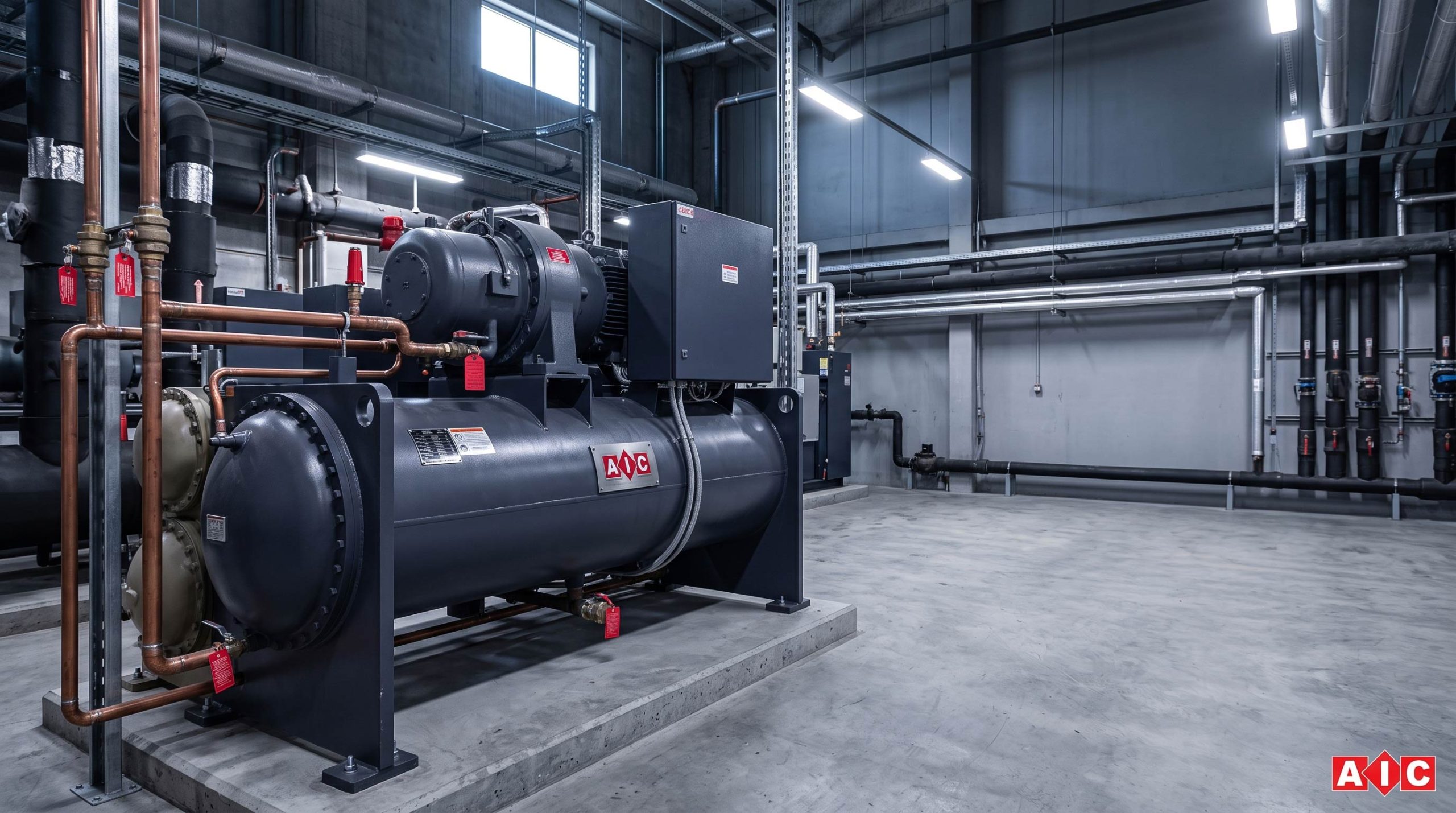
An industrial chiller uses a refrigeration cycle to cool water (or another fluid) to a set temperature. That cold water then absorbs the excess heat of a process or machine. Every vapour-compression cycle has four main parts: the compressor compresses and heats the refrigerant, the condenser rejects that heat to air or water, the expansion valve drops the pressure of the liquid refrigerant, and in the evaporator the refrigerant boils again by taking heat from the process water.
Two decisions that come first
1. Compression or absorption?
Compression chillers run on electricity and are the economical choice for the vast majority of industrial applications. Absorption chillers run on heat (steam, gas or waste hot water) and only make sense when that heat is free or very cheap, for example waste heat from a combined heat and power unit.
2. Water-cooled or air-cooled condenser?
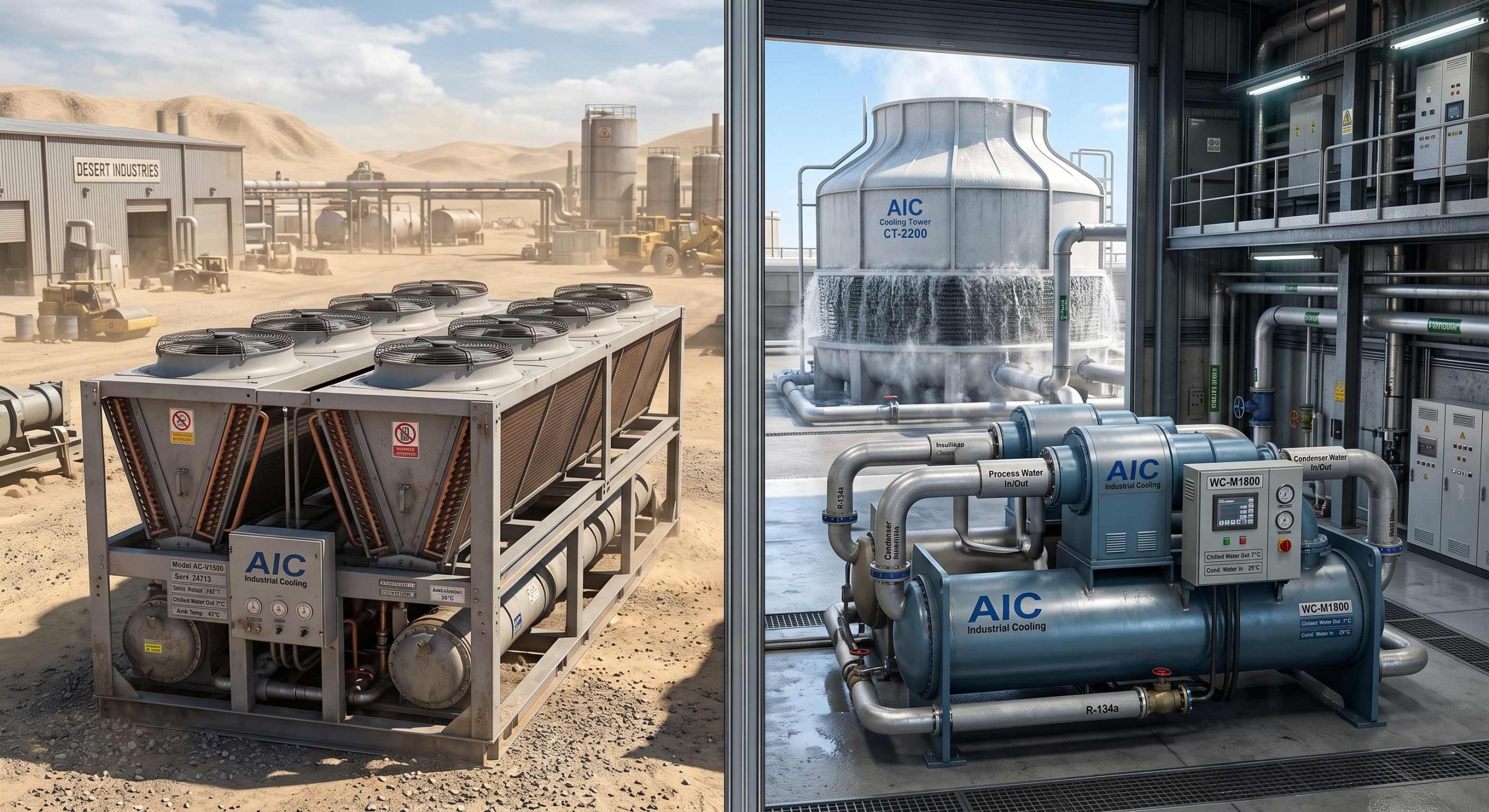
A water-cooled chiller rejects its heat to water that is cooled in a cooling tower. Efficiency is higher, but the system uses water, the condenser can scale up, and it needs a plant room. An air-cooled chiller rejects heat straight to the outside air through finned coils and fans: slightly lower efficiency, but no water consumption and simpler maintenance. The full comparison is in air-cooled vs water-cooled chillers.
The components that decide quality
Compressor
For small and medium capacities, scroll compressors (Copeland, Danfoss) are the most common choice. For larger capacities and continuous industrial duty, screw compressors are preferred for their wider capacity range and stepped capacity control. Ask for the compressor brand and model in writing.
Evaporator
Shell-and-tube evaporators with internally grooved copper tubes are the industry standard at industrial capacities and should withstand a hydrostatic test pressure in the range of 20–30 bar. Heat transfer follows Q = U · A · ΔTlm: when fouling lowers U, the real capacity of the chiller drops. More in how a shell-and-tube heat exchanger works.
Expansion valve and controls
An electronic expansion valve holds superheat more precisely than a thermostatic valve and improves efficiency. A controller that shows high and low pressure, supply and return water temperature and a fault history makes preventive maintenance far easier.
How to calculate the capacity
Getting the heat load wrong is the most common mistake when buying a chiller. Add up three things: the process load (machines, equipment, reactions), the ambient load where relevant (walls, roof, air infiltration) and a design margin, usually 10–15% for future expansion.
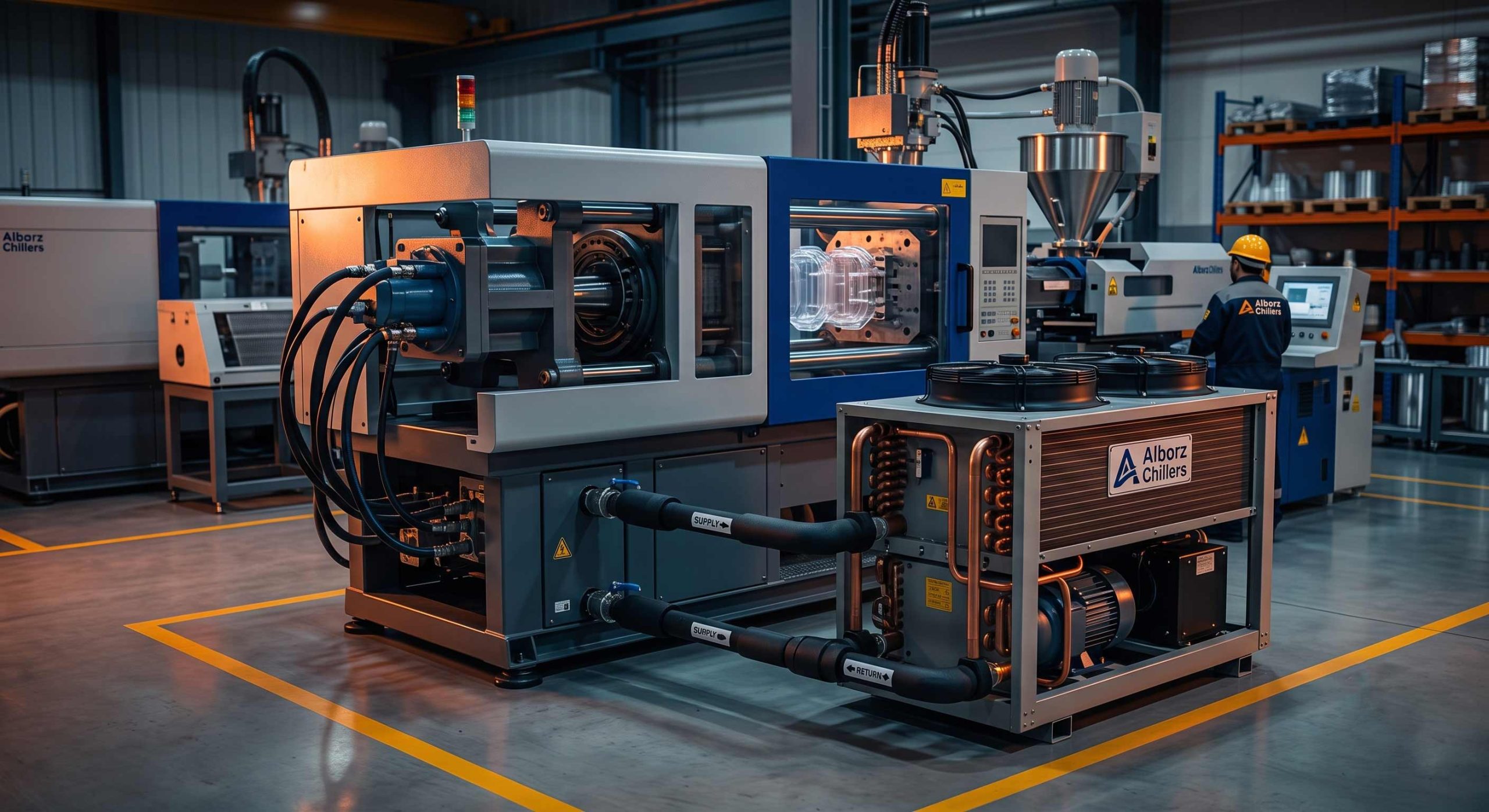
For a water circuit you can work from flow and temperature rise: Q = ṁ · cp · ΔT. For example, 10 m³/h of water warmed by 5 K carries about 58 kW. An undersized chiller never reaches the target temperature and runs flat out all the time. An oversized chiller costs more and cycles on and off too often, which shortens compressor life. For plastic injection, size from shot weight and cycle time, as explained in chillers for plastic injection molding.
Efficiency (COP) and refrigerants
The coefficient of performance (COP) is the cooling output divided by the electrical input. At design conditions it is typically 4.2–5.0 for water-cooled and 2.8–3.6 for air-cooled chillers. Common refrigerants in industrial chillers today include R134a, R407C and R410A. Check which refrigerants are permitted and easy to buy in your country before you order.
Where industrial chillers are used
- Plastic injection: mold cooling to shorten cycle time and prevent warping.
- Food and pharmaceuticals: precise temperature control for heat-sensitive processes.
- Chemical and petrochemical: temperature control of reactors and heat exchangers.
- Textiles and power: cooling of rotating equipment and transformers.
- Medical and data centres: stable temperature for imaging equipment and electronics.
How to compare quotations
There is no single "best chiller". The right one matches your heat load, site design temperature, water quality and operating hours. When you compare offers, look at:
- Real capacity at your conditions. Nominal capacity is not the same as capacity at your ambient temperature and water temperature.
- Efficiency at part load. A chiller spends most hours below full load. Ask for performance at 50% and 75% load.
- Named components. Compressor, expansion valve and controller with brand and model in the written offer.
- Tests and documents. Hydrostatic and performance test results before delivery.
- Support. Access to spare parts and technicians for your site, and written warranty terms.
Ask the manufacturer for a reference project in your industry, a written heat load calculation, the full component list and a maintenance plan. An offer with only a capacity and a price cannot be compared fairly.
Common buying mistakes
- Relying on a rough estimate instead of calculating the heat load.
- Ignoring feed water quality for water-cooled systems and not planning a water softener.
- Choosing an unknown compressor or controller brand to save money.
- No preventive maintenance plan from day one.
- Not checking spare parts and service availability where the chiller will run.
Running cost and service life
The purchase price is only part of the cost. Over a service life of often 15–20 years, depending on maintenance and operating conditions, electricity and upkeep usually exceed the initial price. A sound maintenance routine is covered in industrial chiller maintenance, and fault finding in common chiller errors and how to fix them.
Frequently asked questions
What is the difference between an industrial chiller and a building chiller?
An industrial chiller cools a process or machine and usually has to hold a lower, more stable temperature under a changing load. A building chiller is designed mainly for air conditioning and human comfort.
What matters more, purchase price or running cost?
Over a 15–20 year life, electricity and maintenance usually exceed the purchase price, so judge efficiency and component quality alongside the price.
When is an absorption chiller worth it?
Only when cheap or waste heat (steam, exhaust gas, industrial hot water) is available. Otherwise a compression chiller is more economical.
Was this article useful?
Thanks for the feedback.
Ask an engineer
Write your question about this article. Questions are not made public; only the ones that get an answer appear here, without your email.