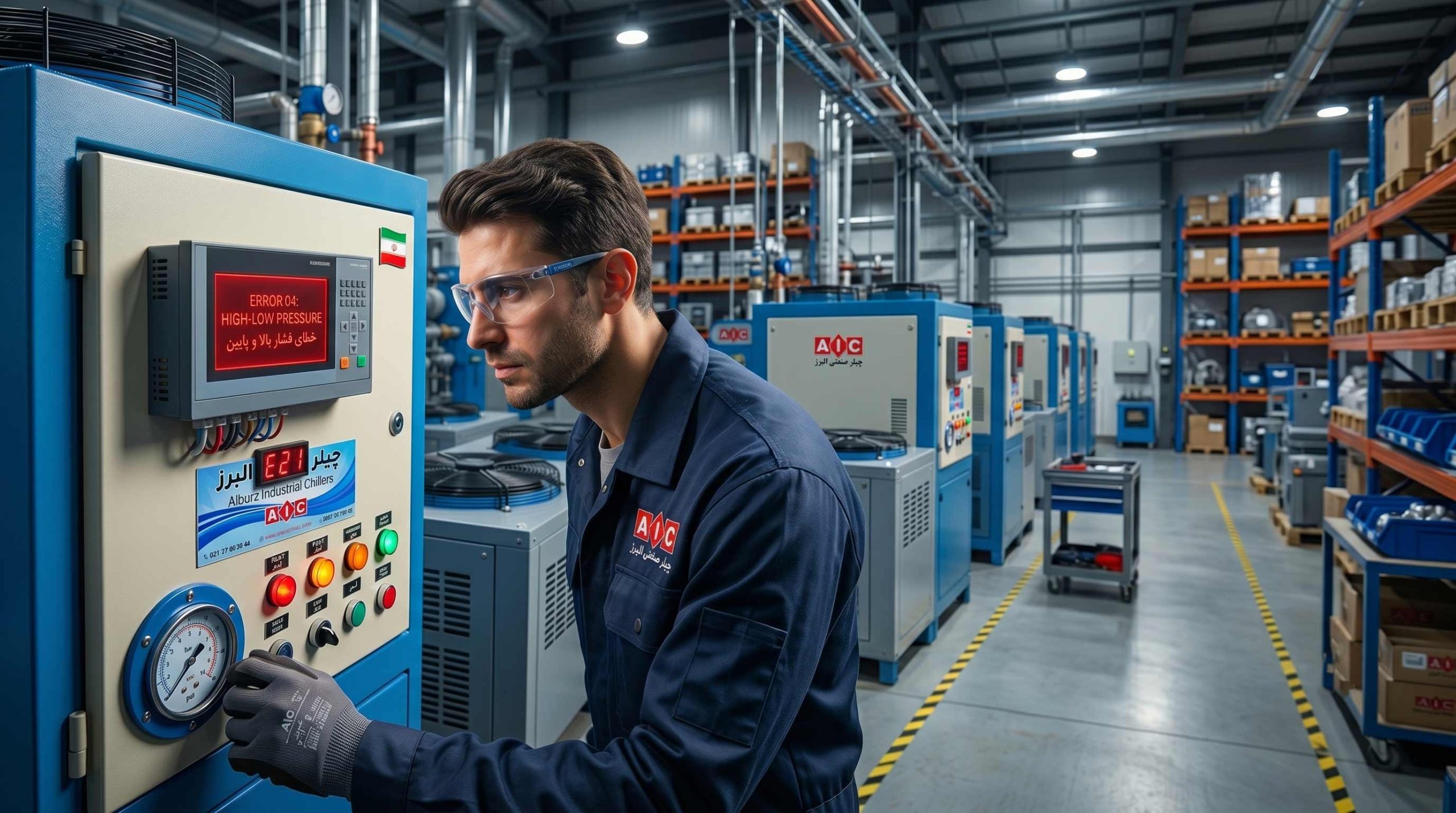
Chillers cool buildings and keep industrial processes running, so a fault quickly becomes a production problem. Faults also push up power consumption and lower efficiency long before the machine stops. If you recognise them early, repair costs fall sharply. Some faults are obvious; others show only as a code on the controller. Below are the twelve faults we see most often on compression chillers.
Note: codes such as CF, DC and RU are common, but every controller manufacturer uses its own list. Always check the code table in the manual of your controller. Refrigeration work involves high pressure and electricity, so leave complex repairs to a qualified technician.
12 common faults on compression chillers
1. The chiller does not start
Usually electrical: no or wrong voltage at the panel, a broken control cable, blown fuses, the main switch off, or a missing phase. Check the incoming supply before anything else.
2. The chiller runs but does not cool enough
Low voltage, wiring faults, failed capacitors, blocked air filters, a very hot installation location or internal compressor wear all reduce cooling capacity.
3. Low or no water flow
Without proper flow, heat transfer stops. Look for pump power problems, closed valves or poor pipework that reduces chilled water flow through the evaporator (and condenser water flow on water-cooled units).
4. CF: compressor failure
The compressor is the heart of the cycle; when it stops, everything stops. A compressor fault usually points to a refrigerant leak, motor overload or a mechanical seizure.
5. DC: dirty condenser
The condenser must reject heat. Dust on the fins of an air-cooled condenser, or scale in a water-cooled one, blocks heat transfer, raises condensing pressure and cuts efficiency. Proper cleaning clears it.
6. Low pressure and a frozen evaporator
Low suction pressure or faulty sensors can freeze the evaporator, which can burst tubes. A failed flow switch or antifreeze (freeze-protection) sensor is a common cause. The controller stops the chiller to protect it.
7. RU: refrigerant undercharge
A leak or loss of refrigerant raises superheat and lowers suction pressure, and the chiller loses cooling capacity. It needs leak detection and a correct recharge by a technician.
8. Low system pressure
Apart from sensor faults, real pressure loss can come from a leak, very low ambient temperatures in winter, a restricted copper line or a failed expansion valve.
9. Unusual noise from the unit
Loose fixings, pipes vibrating because they are not supported, worn fan or compressor bearings, or low refrigerant charge can all cause noise. Treat it as an early warning.
10. Running continuously without reaching temperature
If the compressor and fans run but the water does not cool down, check the cycle itself: a slow pressure loss, hidden condenser fouling or a partly failed control component.
11. Loud compressor
Excessive compressor noise means wear. An incorrect refrigerant charge (too little or too much) or liquid returning to the compressor are frequent causes.
12. Blocked expansion valve
The expansion valve meters refrigerant into the evaporator. Dirt, moisture in the circuit or very low flow can block it, and efficiency drops sharply. A clean, dry circuit and a healthy filter drier prevent this.
Prevention is cheaper than repair
Most of these faults start small: a dirty coil, a slowly falling charge, scale in a heat exchanger. Regular inspection and cleaning catches them early. Our maintenance guide lists what to check daily, monthly and every season.
If you need help diagnosing a fault, the Alborz engineering team can advise you. Call us or send a message from the contact page.
Frequently asked questions
Why does preventive maintenance matter so much?
An industrial chiller keeps a production line running. A breakdown stops production. Regular preventive maintenance extends component life and avoids sudden repair costs.
Why use softened water in water-cooled chillers?
Hard water leaves scale in the copper tubes of the evaporator and the condenser. Scale insulates the tubes and blocks heat transfer. Soft water keeps the chiller at its rated efficiency.
What is acid cleaning of a chiller?
Washing the inside of the heat exchanger tubes (water-cooled condenser and evaporator) with a controlled acid solution to remove hard scale and restore the original heat transfer.
Was this article useful?
Thanks for the feedback.
Ask an engineer
Write your question about this article. Questions are not made public; only the ones that get an answer appear here, without your email.