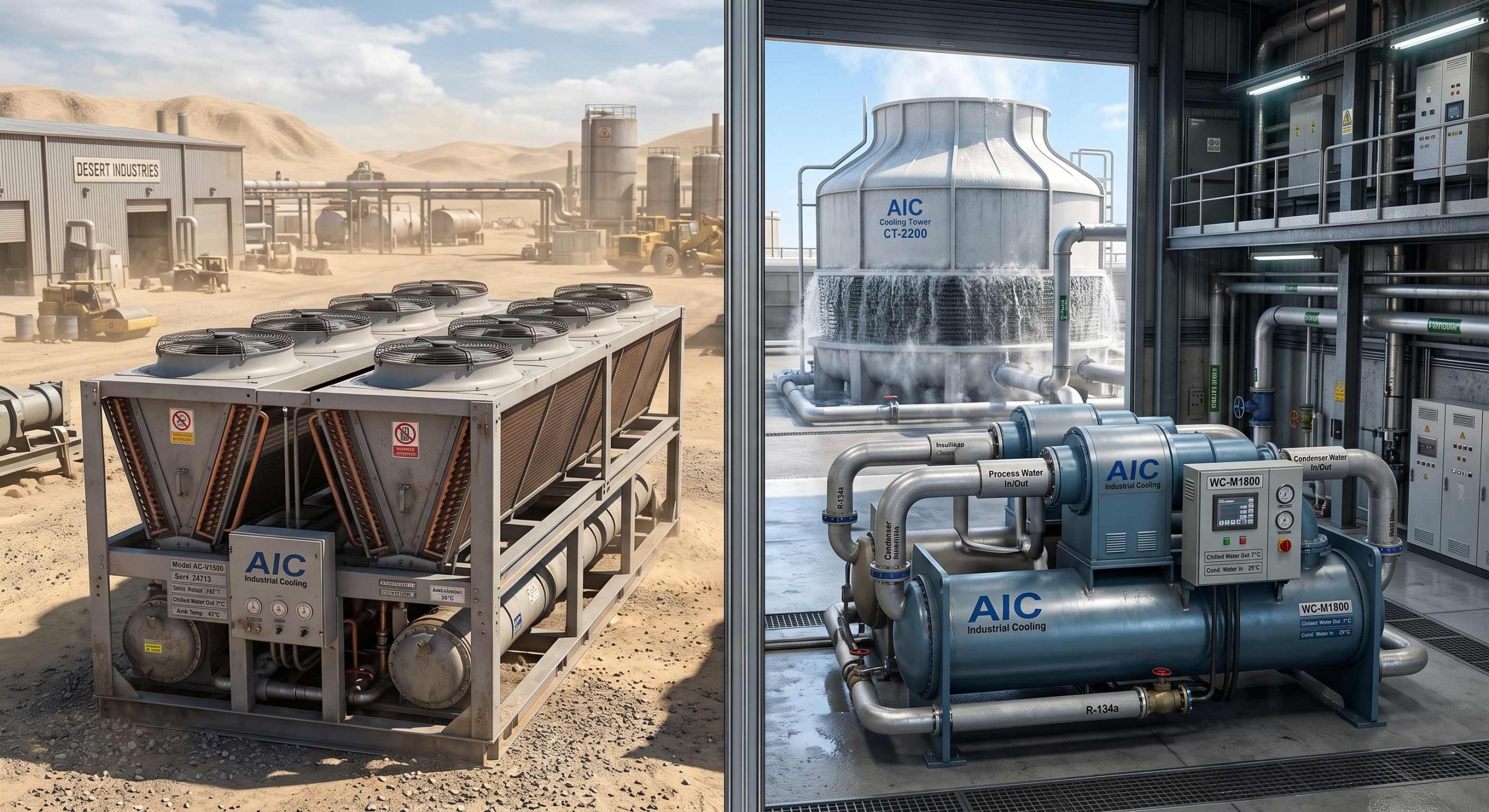
Choosing between an air-cooled and a water-cooled chiller is one of the main decisions when you design a plant's cooling system. Both use the same vapour-compression cycle (compressor, condenser, expansion valve, evaporator). The difference is the condenser and how it gets rid of heat. Here the Alborz engineering team compares the two on thermodynamics and cost of ownership.
Short answer
- Water-cooled: for high capacities, continuous duty and sites with good water and a plant room. Higher COP, but you also need a cooling tower, condenser pumps and water treatment.
- Air-cooled: for most medium-sized plants, dry regions and projects that want simple maintenance. Lower COP, and capacity drops at very high ambient temperatures.
How a water-cooled chiller works
Hot refrigerant gas from the compressor is condensed by water, usually in a shell-and-tube condenser. The warmed water goes to a cooling tower, where partial evaporation cools it. Because tower water approaches the ambient wet-bulb temperature, the chiller condenses at a lower temperature than an air-cooled unit can.
Advantages
- Higher COP: a lower condensing temperature reduces the compressor pressure ratio, so each kW of cooling needs less electricity.
- Smaller unit: a water-cooled condenser is compact and takes less plant-room space.
Disadvantages
- Water consumption: evaporation and blow-down at the tower cost water and treatment chemicals.
- Scale and upkeep: you need a softener, periodic acid cleaning of the condenser and tower maintenance.
How an air-cooled chiller works
The condenser is a coil of copper tubes with aluminium fins (flat or V-type). Fans draw ambient air (the dry-bulb temperature) across the coil and the heat goes straight into the air. There is no condenser water circuit.
Advantages
- No tower or condenser pumps: simpler piping and fewer points of failure.
- Zero water use: the right choice where water is scarce or expensive.
- Simpler maintenance: no water scale; the main jobs are cleaning the coil and checking the fans. See industrial chiller maintenance.
Disadvantages
- Lower COP: condensing temperature follows the outdoor dry-bulb temperature and rises on hot days.
- Capacity loss in heat: for hot climates, select a unit rated for high ambient temperatures.
- Needs open air: a roof or yard with free air flow around the unit.
Comparison table
| Criterion | Water-cooled | Air-cooled |
|---|---|---|
| Typical COP at design conditions | about 4.2–5.0 | about 2.8–3.6 |
| Heat rejected to | Water, then a cooling tower | Outdoor air |
| Follows which temperature | Wet-bulb | Dry-bulb |
| Water use | Yes (evaporation, blow-down) | None |
| Extra equipment | Tower, condenser pumps, water treatment | None |
| Maintenance | Descaling, tower care, water chemistry | Coil cleaning, fan checks |
| Location | Plant room (tower outdoors) | Outdoors with free air flow |
COP values are typical ranges in industrial design; the exact figure depends on the compressor, refrigerant and operating conditions.
Energy cost: a worked example
Take a 500 kW cooling load running 6,000 hours a year. Compressor power is the load divided by COP: about 109 kW at COP 4.6 (water-cooled) and about 156 kW at COP 3.2 (air-cooled). The 47 kW difference adds up to roughly 285,000 kWh a year. That figure excludes the tower fan and condenser pumps of the water-cooled system, which win back part of the gap. The fair comparison is total cost of ownership: energy, water, maintenance and capital.
Our view: for many medium-sized plants (plastic injection, pharmaceuticals, food), an air-cooled chiller lowers the risk of a production stop because there is no tower, condenser pump or water treatment to fail. The price is higher power use. For large loads and round-the-clock duty, calculate the cost of ownership and decide on that basis.
When to choose which
- Choose water-cooled if you need a very large capacity, run 24 hours a day, have good and cheap water, and have a team to maintain the tower.
- Choose air-cooled if water is limited or expensive, you want no dependence on a tower, you have suitable outdoor space and the capacity is moderate.
Frequently asked questions
Which is better in a hot, humid climate?
In humid air the wet-bulb temperature is high, so a cooling tower cannot cool the water much and the COP advantage of a water-cooled chiller shrinks. An air-cooled chiller also loses capacity at high dry-bulb temperatures, so choose a high-ambient model. Decide from your local design temperatures (dry and wet bulb) and water availability.
Can an air-cooled chiller go in a plant room?
Usually not. It needs a large volume of fresh air. In a closed room without designed ventilation, hot air is drawn back into the coil, condensing pressure rises and the chiller trips on high pressure.
Why does an air-cooled unit cost more?
The larger copper-aluminium coil and the fans raise the unit price. In return you save the cooling tower, pumps and condenser piping, so compare the cost of the whole project.
Which type suits plastic injection?
For most medium-sized injection workshops, an air-cooled chiller is the usual choice. Sizing is explained in chillers for plastic injection molding.
Was this article useful?
Thanks for the feedback.
Ask an engineer
Write your question about this article. Questions are not made public; only the ones that get an answer appear here, without your email.