Factories, hospitals and large buildings run machines and air conditioning around the clock, and all of that equipment produces heat. If the heat is not removed, machines overheat and fail. In water-cooled systems, the cooling tower is the device that finally sends this heat to the atmosphere. This article explains what a cooling tower is, its parts, the main types and how it works with an industrial chiller.
What is a cooling tower?
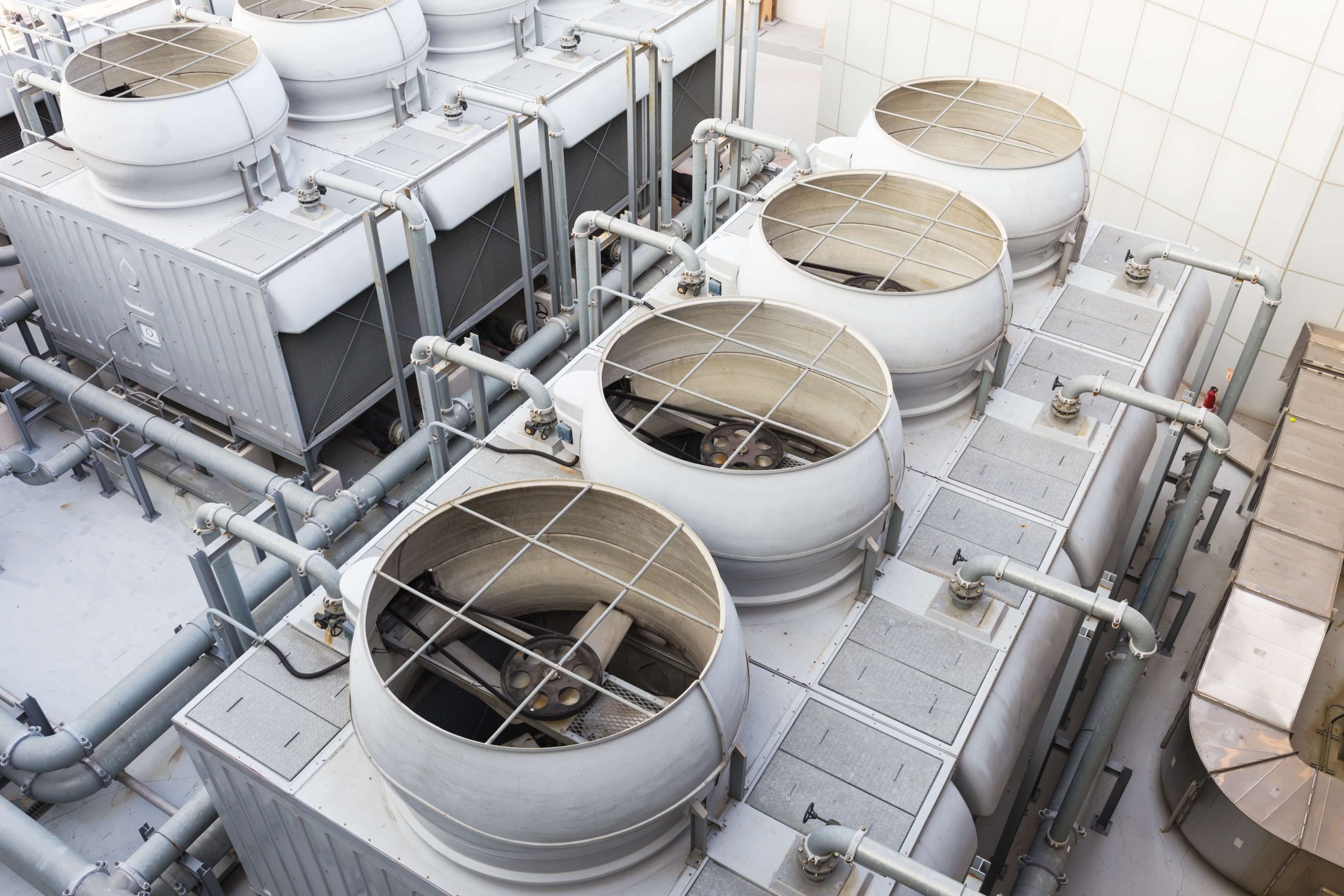
A cooling tower is a water cooler that removes heat by evaporating a small part of the water. Warm water is brought into contact with a stream of air; a little of it evaporates, and the energy needed for that evaporation is taken from the rest of the water, which leaves the tower cooler. Because evaporation is involved, the water can be cooled close to the ambient wet-bulb temperature, which is lower than the air temperature you feel.
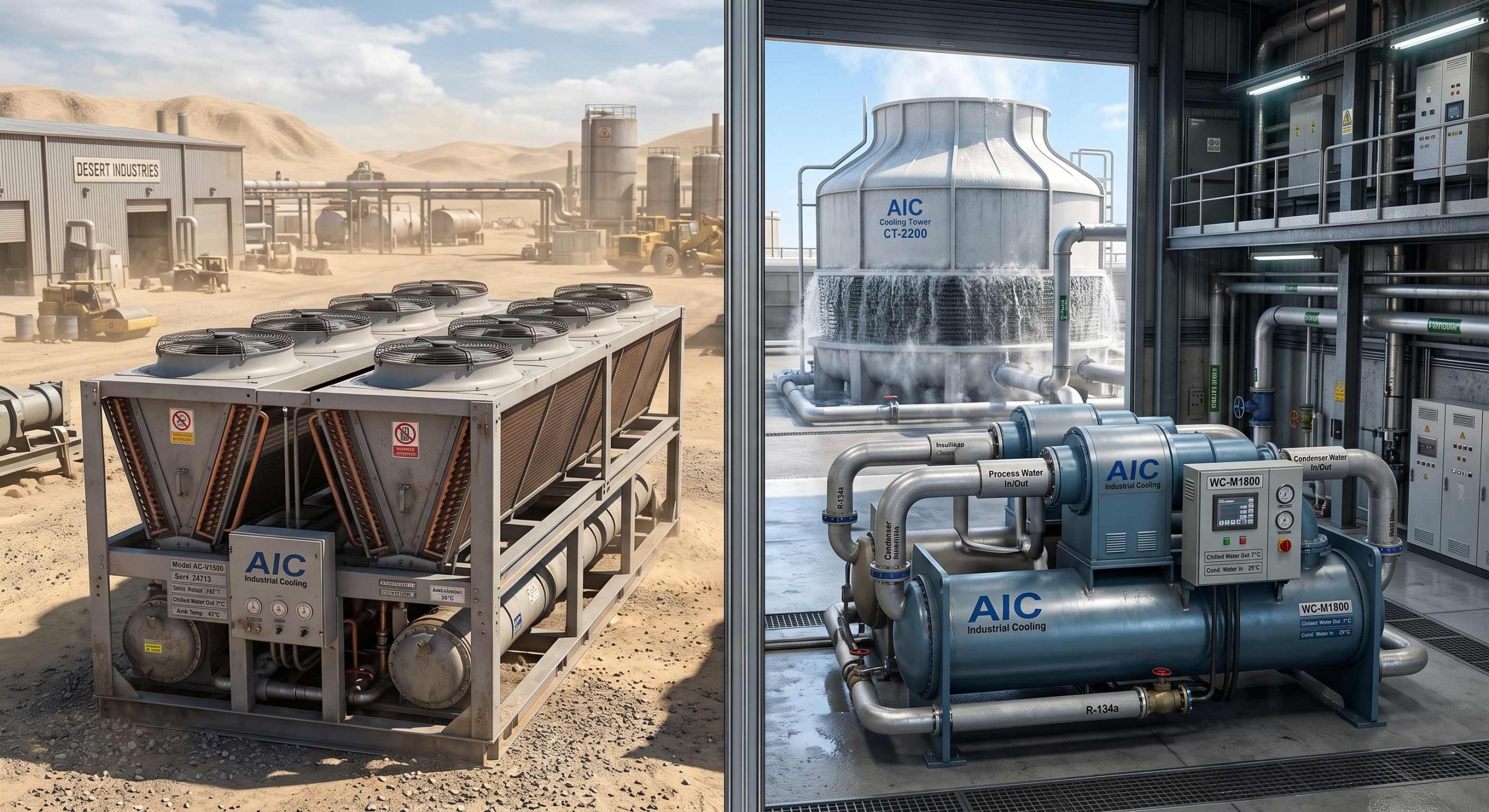
With a water-cooled chiller, the tower takes the warm water leaving the chiller's condenser, cools it and sends it back. This is why water-cooled chillers condense at a lower temperature and reach a higher efficiency than air-cooled ones. See air-cooled vs water-cooled chillers.
Main parts of a cooling tower
- Fan: moves air through the tower. Fans are either axial or centrifugal.
- Spray nozzles: spread the hot water evenly over the fill and break it into droplets, which increases the contact area between water and air.
- Fill (packing): spreads the water into thin films so more surface is exposed to the air and evaporation is easier.
- Basin: collects the cooled water at the bottom of the tower.
- Water connections:
- Make-up: connected to a float valve that keeps the basin level constant, replacing water lost to evaporation.
- Overflow: drains excess water if the float valve fails.
- Drain / blow-down: because the water is in direct contact with air it collects dirt and minerals; dirty water is drained and replaced with clean water.
- Inlet and outlet: where the warm water enters and the cooled water leaves.
Types of cooling tower
Open-circuit towers
The process or condenser water is in direct contact with the air. It is sprayed over the fill, where thin water films create a very large contact area and evaporation is easy. Cooled water collects at the bottom and the saturated air leaves at the top. Open towers are simple and efficient, but the water picks up dust and needs treatment.
Closed-circuit towers
The process water flows inside a heat exchanger coil in the tower and never touches the air. A separate spray water circuit wets the outside of the coil, and the air passing over it helps that water evaporate. The process water stays clean and water losses are much lower, which is why closed-circuit towers are widely used where water quality matters.
How to size a cooling tower for a chiller
The tower has to reject the condenser heat, which is roughly the cooling load plus the compressor power: Qcond ≈ Qevap + Wcomp. It must do this at the design wet-bulb temperature of your site. The closer you want the return water to approach the wet-bulb temperature (the "approach"), the larger the tower. Water quality also matters: hard water scales the condenser and the fill, so plan for a softener and regular blow-down.
Alborz builds cooling towers with catalog ratings of 30, 50 and 100 tons: see the Cooling Tower 1000, 2000 and 4000. Send us your project conditions and we will check the selection with you.
Was this article useful?
Thanks for the feedback.
Ask an engineer
Write your question about this article. Questions are not made public; only the ones that get an answer appear here, without your email.