A shell-and-tube heat exchanger is the most common type of industrial heat exchanger: a bundle of tubes sits inside a cylindrical shell, and heat passes between the fluid inside the tubes and the fluid flowing around them in the shell. In an industrial chiller it works as the evaporator or the condenser. This guide explains the construction, the main types, a worked calculation and how to choose one.
Summary
- Principle: two fluids exchange heat through the tube wall without mixing (tube side and shell side).
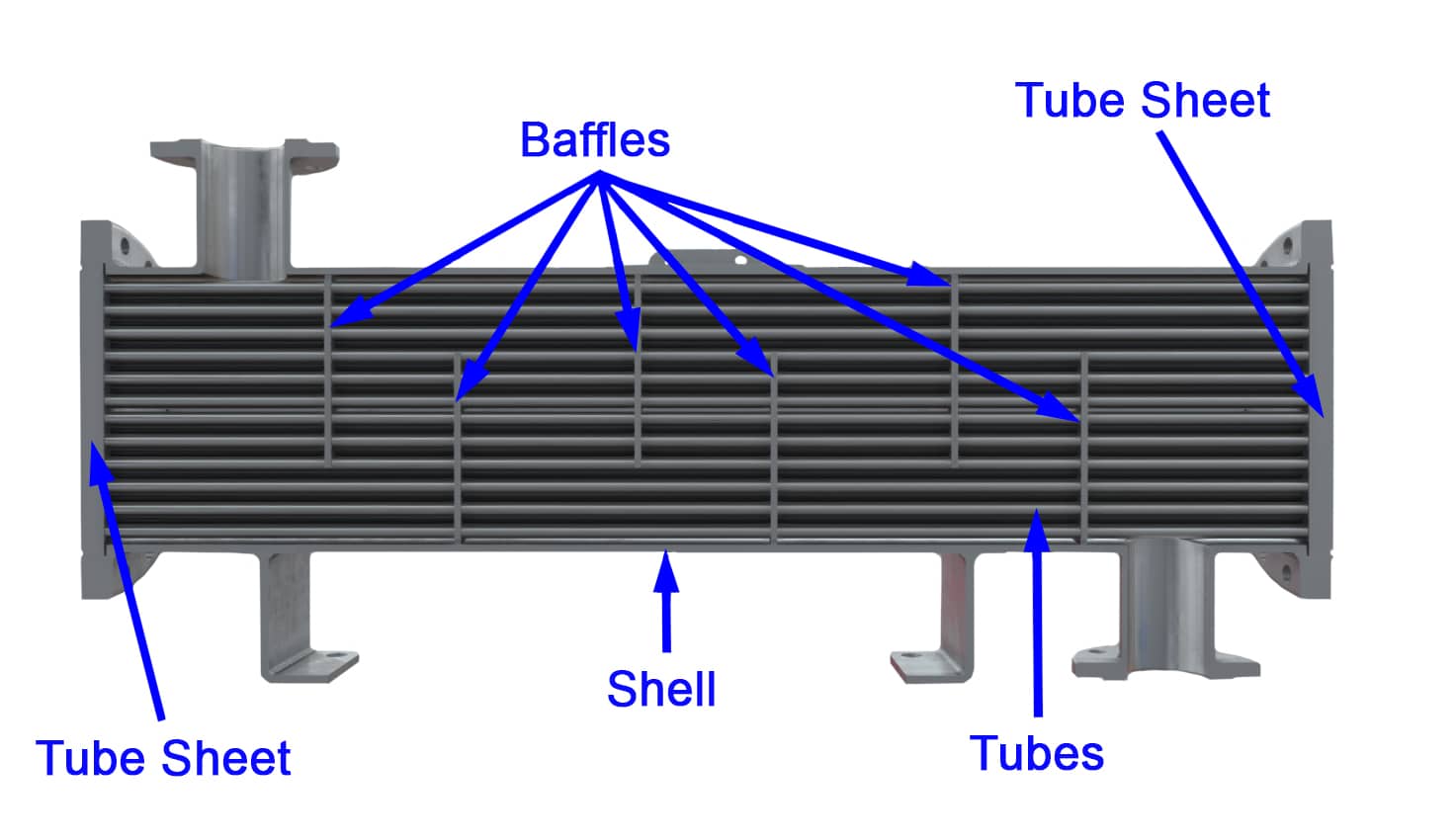
- Main parts: tubes, tube sheets, baffles, shell, heads (channels) and nozzles.
- Common TEMA types: fixed tube sheet, U-tube and floating head. They differ in how they handle thermal expansion and how easy they are to clean.
- Sizing rule: Q = U · A · ΔTlm. Fouling lowers U, and real capacity drops.
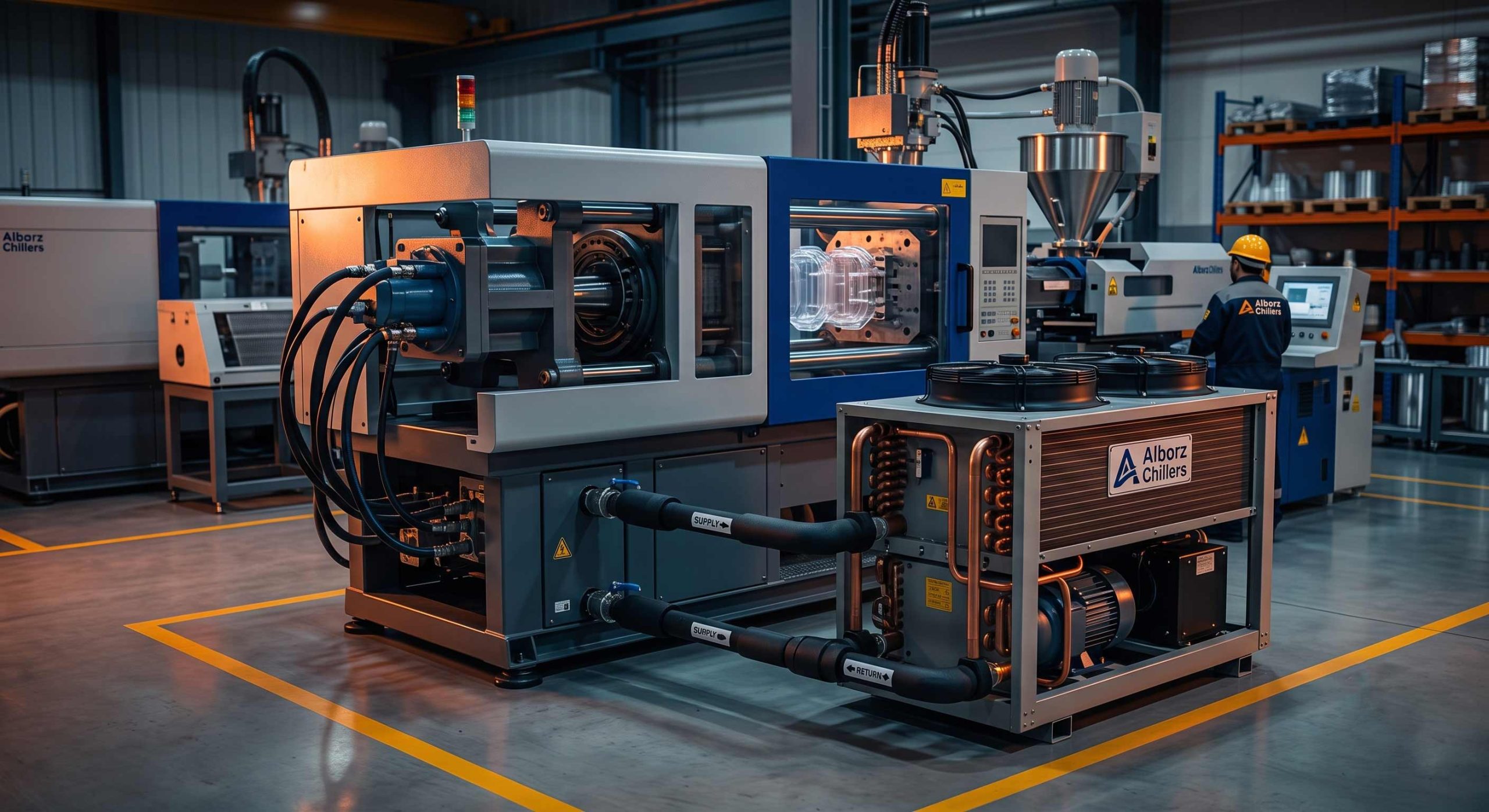
- In a chiller: the evaporator (cools the process water) and the water-cooled condenser (rejects refrigerant heat to tower water).
How it works
One fluid flows inside the tubes (tube side), the other through the space between the tubes and the shell (shell side). Heat moves from the warmer fluid through the tube wall to the colder one. Flows are usually arranged in counter-flow, which gives a larger effective temperature difference. Baffles force the shell-side fluid to cross the tube bundle several times, raising its velocity and the heat transfer coefficient.
The tube-side fluid can make one, two or four passes. More passes mean higher velocity and better heat transfer, but also a higher pressure drop. For water, tube velocity is typically kept at about 1–2.5 m/s: slower and scale settles, faster and erosion becomes a risk, especially in copper tubes. The manufacturer's datasheet sets the exact value.
The engineering formula
Q = U · A · ΔTlm, where ΔTlm = (ΔT1 − ΔT2) / ln(ΔT1 / ΔT2) and 1/U = 1/Uclean + Rf.
- Q: heat transferred (kW)
- U: overall heat transfer coefficient (W/m²·K)
- A: tube surface area (m²)
- ΔTlm: log mean temperature difference
- Rf: fouling resistance
In practice, fouling raises Rf and lowers U. To move the same heat, the temperature difference has to grow. In a chiller that means a higher condensing pressure (or a lower evaporating pressure), more electricity and a lower COP. Designers therefore add a fouling allowance that matches the water quality.
Worked example: evaporator of a 50 kW chiller
The evaporator must remove 50 kW from water cooled from 12 °C to 7 °C, with the refrigerant evaporating at about 2 °C. The temperature differences are ΔT1 = 12 − 2 = 10 K and ΔT2 = 7 − 2 = 5 K, so ΔTlm = 5 / ln 2 ≈ 7.2 K.
If fouling brings U down to 600 W/m²·K, the required area is A = 50,000 / (600 × 7.2) ≈ 11.5 m². With a cleaner surface (higher U) the same load needs less area. Otherwise the chiller has to evaporate colder to keep up, and COP falls. This is why a margin for fouling is built into the surface area. These figures are a teaching example, not a final design.
Main TEMA types
- Fixed tube sheet: simple and economical; the shell side cannot be cleaned mechanically, and large temperature differences need an expansion joint.
- U-tube: the bundle expands freely; the inside of the U-bends is hard to clean mechanically.
- Floating head: the bundle can be pulled out and both sides cleaned; more expensive.
Shell-and-tube exchangers in a chiller
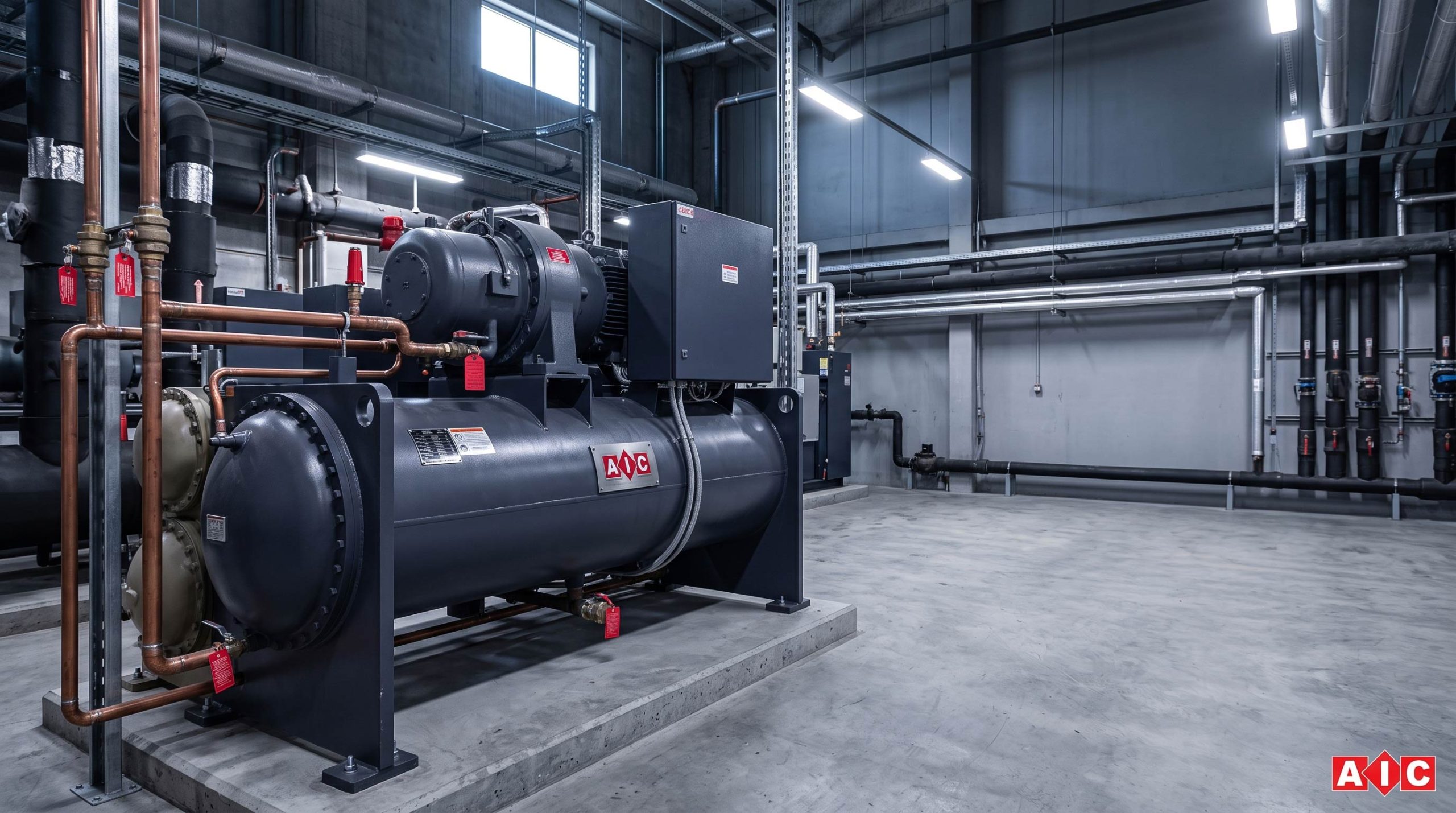
- Evaporator: in direct-expansion (DX) designs the refrigerant usually evaporates inside the tubes while the process water flows around them on the shell side. In flooded evaporators the refrigerant is on the shell side.
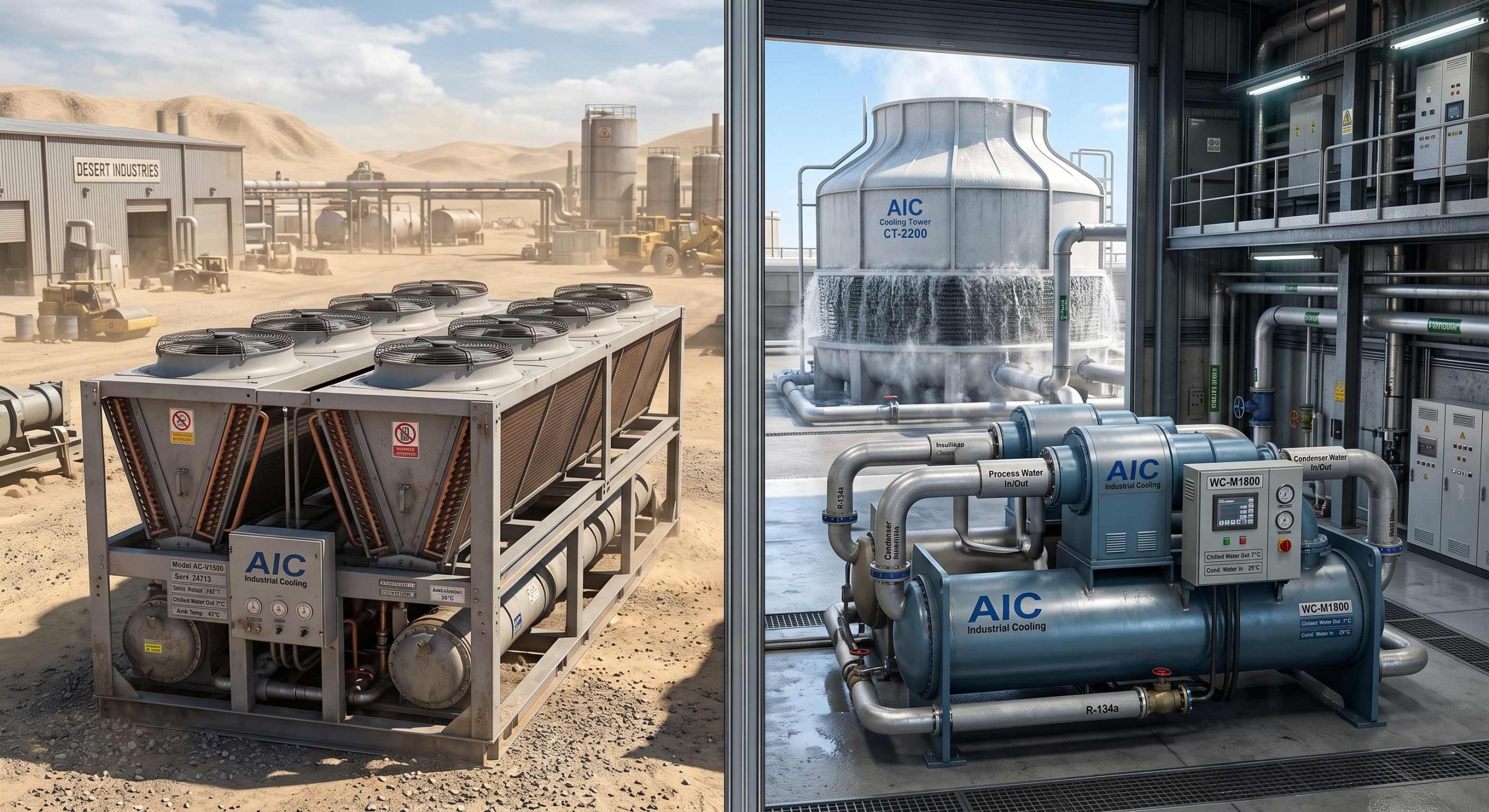
- Water-cooled condenser: refrigerant vapour condenses on the shell side and tower water flows through the tubes, so the tubes can be cleaned with brushes or chemically.
The hydrostatic test pressure must match the design pressure and the construction code. The shell-and-tube exchangers in Alborz chillers are pressure tested at about 20–30 bar. Alborz uses these exchangers inside its own chillers and does not sell them separately.
Shell-and-tube or plate heat exchanger?
For high-capacity industrial chillers and water that tends to scale, shell-and-tube is the safer choice. For smaller capacities and clean water, a plate heat exchanger is more compact and cheaper, but its narrow channels block more easily.
Advantages and limits
- Advantages: can be cleaned mechanically and chemically, handles high pressure and temperature, flexible choice of tube material, widely built and repaired.
- Limits: larger and heavier than a plate exchanger, lower heat transfer per unit volume, and it needs space to pull the bundle during service.
Maintenance and descaling
Signs of a fouled condenser are a slowly rising approach (the difference between condensing temperature and leaving water temperature) and rising discharge pressure. Water-cooled shell-and-tube condensers are usually cleaned by brushing the tubes or by chemical cleaning with a corrosion inhibitor. High-pressure water jetting is not recommended for evaporators. Freeze protection (flow switch, glycol) is essential. See industrial chiller maintenance.
Frequently asked questions
What exactly does a shell-and-tube heat exchanger do?
It transfers heat between two fluids without mixing them: one flows in the tubes, the other in the shell, and heat passes through the tube walls.
How many passes should the tube side have?
More passes raise tube velocity and heat transfer, but also the pressure drop and pumping power. The number of passes is a balance with the allowed pressure drop.
How can I detect fouling early?
Watch for a gradual rise in approach temperature, discharge pressure and water-side pressure drop. Logging these values every day shows fouling months before it becomes a problem.
What does a shell-and-tube exchanger cost?
There is no fixed price. It depends on the surface area, tube material, TEMA type and design pressure. Alborz does not sell exchangers separately; they are built into our chillers.
Was this article useful?
Thanks for the feedback.
Ask an engineer
Write your question about this article. Questions are not made public; only the ones that get an answer appear here, without your email.